Thursday, January 10, 2008

My Top Ten of the 21st Century

1. The Producers (2005, Susan Stroman)


Hilarious, bold, brilliant. Mel Brooks's classic Broadway musical is finely turned into a terrific motion picture adaptation by stage director Susan Stroman. The cast is in perfect form, particulary Nathan Lane who plays the sad-sack producer Max Bialystock with the right amount of humour and pathos. Matthew Broderick gives Leo Bloom a nice sense of innocence, even while pulling off the ultimate scheme. Uma Thurman, Will Ferrell, Gary Beach and Roger Bart also pulls off their parts brilliantly. Coupled with fantastic songs, amazing song-and-dance numbers and a show-within-a-film that has to be seen to be believed, The Producers is without a doubt the best film of the decade.

2. Spirited Away (2001, Hayao Miyasaki)


Quite possibly the best animated film of all-time, Hayao Miyasaki fills this wonderous story full of beautiful colour and fantastic characters. The main character of Chihiro is an independent young girl, who tries to make it in this world, and even though she's a drawing, Miyasaki makes her feel like a real personality. Joe Hisaishi's score combined with Ghibli's animation (probably the best animation unit in the world) created a seamless blend of perfection that only Disney can even come close to.

3. The Lord of the Rings: The Return of the King (2003, Peter Jackson)


A incredibly epic adventure and a brilliant conclusion to a very good trilogy, The Return of the King is amazing entertainment from start to finish. Its three hour running time doesn't hinder the film in the least. Everybody in the cast succeeds, particularly Andy Serkis as Gollum and Ian McKellen as Gandalf. The special effects are absolutely brilliant and the best of the modern film era. A compelling story, this is Peter Jackson's finest hour (make that three hours). It may just be about people walking to a fucking volcano, but hell, I enjoy it a lot.

4. Capote (2005, Bennet Miller)


A pitch-perfect performance from Philip Seymour Hoffman helps make this film more than just your typical "true story." He embodies Truman Capote, not just doing an impersonation, but actually transforming into the neurotic author of In Cold Blood. Bennett Miller's only other previous credit is of a documentary and that is quite evident with his direction here. The film feels real, like we're watching Capote at work and not necessarily Hoffman at work. Dan Futterman's screenplay shows the pains that can happen when writing a real figure and how far a man can go for a book, even if it destroys him. Catherine Keener also does some great work as Harper Lee with the other big actor of the picture, Clifton Collins Jr, giving a chilling and intense performance as the infamous Perry Smith. Slow and calculating, Capote is already a classic in my eyes.

5. The Royal Tenenbaums (2001, Wes Anderson)


Wes Anderson's very funny character study on the family unit, this isn't just another film about a dysfunctional and quirky family. This is a comedy that brings upon the idea of how one major event (whether true or not) can bring them together. Filled with an impressive ensemble cast, a clever screenplay, an un-pretentious direction and a splendid soundtrack, this is a film that is both very entertaining but also causes one to think about how family is important. Godard would be proud.

6. The Departed (2006, Martin Scorsese)


An example of an American remake that can be miles above the Oriental original film, The Departed is an intense thriller that isn't afraid to pack any punches. Martin Scorsese's direction is perfect and despite taking place in Boston, his New York intellect is still intact. William Monahan's screenplay may be profanity-laced, but it's perfect to boot with its odes to Shakespeare sprinkled throughout and wonderful to spot and one of the best endings in years. Plus, there's DiCaprio, Damon, Nicholson, Wahlberg, Sheen, Baldwin, Winstone, Farminga. Who could ask for a better cast?

7. Stanley Kubrick: A Life in Pictures (2001, Jan Harlan)


A fascinating and well edited look at the impressive career of filmmaker Stanley Kubrick, this documentary is not just a smattering of praise. It looks deep into what made his films so interesting as well as the persona he kept so hidden from the public. Jan Harlan (the film's director), Malcolm McDowell, Woody Allen, Steven Spielberg, Christiane Kubrick and a batch of other interesting interviewees supply plenty of thoughts on Kubrick himself as well as his films. This is a special documentary that should be seen by any Kubrick fan. It's that essential.

8. The Last Shot (2004, Jeff Nathanson)


Featuring two fantastic lead performances and a hilarious screenplay, The Last Shot is un under-rated gem. Matthew Broderick is perfect as Steven Schats, an aspiring director. He fills him with enthusiasm, creating an incredibly relatable character. In fact, this character reminds me so much of myself, it's insane. Alec Baldwin also does incredible work as the under-cover FBI agent posing as a film producer. He adds plenty of warmth to his performance, instead of going for a tough guy routine that other actors might have given him. Baldwin is touching and his chemistry with Broderick is pitch-perfect. Toni Collette, Tony Shalhoub, Joan Cusack and James Rebhorn also do some fine work in their smaller roles. Jeff Nathanson's screenplay captures the wide-eyed wonder of Hollywood terrifically, bringing plenty of hilarious one-liners and jokes. This certainly stands as one of the best of the decade so far.

9. The Dreamers (2003, Bernardo Bertolucci)


Bernardo Bertulocci takes an erotic angle on the minds of film aficionados with this well-roven drama of an American teenager and the two French twins he befriends in Paris during the period of the Student Revolution. Eva Green gives a perfect performance as the lead female as she blends naturally into the part. Michael Pitt and Louis Garrel do fine work as the other two leads (though they're no match for Green). An essential for any film fan, this is also educational as it talks about an important historical event and could even lead some people to watch some Chaplin, Keaton and Godard as well.

10. Catch Me If You Can (2002, Steven Spielberg)


Yet another terrific film from Steven "The Man" Spielberg, Catch Me If You Can is a fun journey through the world of a young man doing every person's dream. Leonardo DiCaprio plays Frank Abagnale, Jr. with a charm that echoes Johnny Depp and Matthew Broderick, among others. And in the film's more dramatic moments, he delivers just as well. I would probably say this is my favourite DiCaprio performance. Tom Hanks, Christopher Walken and Amy Adams also do fine work in their roles. Everything else is top-notch as well. The screenplay, the cinematography, the costumes, the soundtracks, the art direction, the editing and of course, Stevie's direction. Incredible that even at 60 years old, it seems as if Spielberg hasn't gotten older (though he's certainly matured).

Honorable Mention: Match Point (2005, Woody Allen)


For many years, Woody Allen shot his films in New York, showing neurotic characters discussing that they "would never want to belong to any club that would have someone like me for a member", quoting the old Groucho Marx quote. With Match Point, the clarinet-playing, Marx-quoting Allen moved to a totally different city: London, England. And thus, there is a change of pace from nervous, neurotic individuals to confident people looking to climb the social ladder. As typically happens when an American filmmaker puts his lens on Britain, audiences are treated to the upper-crust of English society and for Match Point, it works. Match Point also lacks the feel of a Woody Allen film, which makes it even more fascinating as he allows the actors to work on their terms, reading his written lines with enough of their own feel. And particularly what sets this film apart from previous Woody fare is the darkness of the production. While he has tackled dark films before with the Bergman-inspired Interiors and Crimes and Misdeamenors (which this film borrows heavily from), never has he attempted to make a psychological thriller. Match Point isn't like, say, The Silence of the Lambs, but it does have a suspenseful feel lurking around it.

Monday, December 24, 2007

The magic of Cinema Paradiso (1989)

Beautiful, absolutely beautiful. Cinema Paradiso is perfection and the best world of foreign cinema has offered. The film that defines the power of cinema the best, this is a revelation and after many years, I will still consider it to be one of the two greatest films of all-time (along with Chaplin's Modern Times). Giuseppe Tornatore's direction and screenplay is an inspiration, with its charm, humour and beauty. Every cast member delivers an impressive performance, giving it their best and adding to the wonderment of the film. Then, there's Ennio Morricone's brilliant score. His best work to date, the music of Cinema Paradiso is an emotional tour-de-force hitting the right keys and producing a melody that will remembered for all eternity. As the film goes through the three major time periods of the protagonist's life, we are immersed all throughout by how the art of film touched and helped mold this boy's life. And then comes the touching final twenty minutes, that are sure to bring a tear to just about everyone who watches it. It's a commentary on how the cinema has unfortunately fallen in this technology-filled time period, but the films still stay the same, enchanting us through our whole lifetime. All this leads up to one of the greatest film endings ever made: a montage of screen kisses, set to Morricone's classic score, a heart-breaking moment that will certainly bring forth many good memories to all viewers. If I were to make a selection of films to show at a classic film festivals, I would proudly give Cinema Paradiso the honour of being the closing night film.

Sunday, December 23, 2007

Sweeney Todd: The Demon Barber of Fleet Street (Tim Burton, 2007)

Sweeney Todd: The Demon Barber of Fleet Street

As per typical of Tim Burton, this film is a visual triumph, succeeding incredibly well in art direction, costumes, cinematography and makeup. The German Expressionism influences are obvious and that's what makes this film even more fun, as it's a German Expressionist film set to music. Having never heard much of Stephen Sondheim's work, I didn't know what to expect from the songs, but I must say I was impressed. Some memorable tunes and funny lyrics add to the fun of the film, particularly when Helena Bonham Carter sings them.

Regarding the actors, Johnny Depp is very good, although I did catch a hint of Jack Sparrow sometimes. He's a decent singer too, but nothing extraordinary. Helena Bonham Carter was my favourite in the cast, playing her character incredibly. She's a tragic figure, who you can't help but sympathise for and Carter's performance adds to this. She's a great singer as well. Alan Rickman, as usual, is fantastic despite nothing having that much screen time. He has a fairly good singing voice, too. Timothy Spall and Sacha Baron Cohen provide plenty of dark comic relief in their parts, too. I didn't particularly care for the two actors playing Joanna and Anthony, though. Despite good singing, I found them rather uninteresting.

The film gets off to a slow start, but once the killings start (and boy does Burton do a great job with those), it gets more exciting. Those two hours passed by very quickly. My favourite musical of the year (but I still need to see Across the Universe).

The embarassment that is the Super Mario Bros film

"Wasted opportunity" is the phrase that instantly comes to mind, when one thinks of the immense failure of the Super Mario Bros. film adaptation of the classic video game. One of the most popular games on the Nintendo console, The Super Mario Brothers series is a fun way to pass a couple of hours. The story of the game is simple: a plumber must save the Princess from the evil overlord of her kingdom. Granted, it's not a particularly intellectual plot, but it's one that has been used very successfully many times before, from Robin Hood to Star Wars. With a talented screenwriter and some good direction, a Super Mario movie could have been a fun romp for children, teenagers and adults as well. Unfortunately, the film hoisted upon fans in 1993 was far from a good film. Super Mario Bros. is a gigantic piece of un-recycled product that is not deserving of the title given to it. The fact that it was produced by the man responsible for The Killing Fields and starred a talented group of award-winning actors makes this more embarrassing for not only them, but also us having to watch them make a fool of themselves.

The plot of Super Mario Bros. is such an incoherent mess, it's as if they took the three drafts of the screenwriters and just mixed them up into one big pile. Mario Mario (Bob Hoskins) and Luigi Mario (John Leguizamo) are two brothers (or are they father and son, as the film isn't particularly clear on that) who run a plumbing business, which isn't exactly the most successful. One day, Luigi meets Daisy (Samantha Mathis), an archaeologist and he falls in love with her. When she is kidnapped by the henchmen of the evil King Koopa (Dennis Hopper), Mario and Luigi go off to save her. They land in a mysterious big city hidden underneath New York City, populated by dinosaurs that have evolved into human beings. Soon, they find out that Koopa wants the rock around Daisy's neck so that he can go up to the surface and rule over the Big Apple. Now, it's up to the Super Mario Brothers to save the day.

To start off, the biggest problem with Super Mario Bros. is the fact it is absolutely nothing like the video game. The plot of the game, while simplistic, still works. The story that the film brings forth throws everything away and substitutes it for the ridiculous mess described in the previous paragraph. In fact, the only things that the film has in common with the game are the character names and the title. An adaptation does not necessarily have to be faithful to the source material, but taking away what made the original story work will certainly make the final version smell like rotten waste disposal, for both fans and general filmgoers. The screenplay is filled with jokes that aren't funny, action scenes that are just boring and characters with minimal character development. When a 16-bit video game excels better in all of the above listed aspects, there is definitely something wrong with the film version.

The film also fails on a visual level. Super Mario Bros. is a dark film that while marketed for children, it definitely does not feel like it was intended for them. The sets are particularly disappointed, seeing as they could have saved the film. A Manhattan version of the Mushroom Kingdom sounds like a promising idea, but the filmmakers once again ruin the opportunity to bring something good to the proceedings. Super Mario Bros. looks as if they stole the set from Blade Runner and sneezed all over it. It's enough that they practically copy the style, but they essentially rip out what made that film look sleek. If Rick Deckard showed up in that city, he would have had a heart attack at what the set designers had done. The special effects also fall into the category of "poor." What makes that aspect of the film really bad is that despite being a Hollywood film on a big budget, the effects look like those of B-movies from the 1960's.

Finally, the final aspect of Super Mario Bros. that could have saved it also fails. Bob Hoskins puts on the same accent he did for his character in Who Framed Roger Rabbit. Unfortunately, the superb work he brought to the screen in that film doesn't surface here. He just looks bored, wanting to leave the set immediately so he can go to the bank and cash his paycheque. I think I even saw one scene where he breaks character and glances at his watch. John Leguizamo doesn't fare much better as he's given the film's most banal and uninteresting character as well as dialogue. Through most of the film, he's just staring off into space. The same goes for Samantha Mathis, who is just dull. The actor in the film I feel the most sorry for is Dennis Hopper, though. Not only is the "comedic" material he is provided with not that funny, he also hams it to the max in his performance. He puts on different voices from a Baltimore accent to a Donald Trump impression and all seem to fail badly. You haven't seen the Easy Rider star until you watch him gleefully say "Monkey!" like a five year old. Or better yet, don't!

Roger Ebert has taken on some recent controversy for publicly stating that video games are not art. This isn't a discussion I want to get into the middle of right now, but comparing the joys of pressing those colourful buttons to the horrific experience of watching this film, I have to side with the game enthusiasts on this one.

The infamous "Monkey!" line, spoken by Dennis Hopper in the film.

Friday, December 21, 2007

A great adventure story: Jurassic Park (1993)

Sure, the acting isn't perfect (except for Jeff Goldblum) and there are some un-interesting stretches when there isn't any dino action, but Jurassic Park certainly is a bucket-load of fun. Steven Spielberg's direction is splendid as usual, as he brings both warmth, adventure and terror to the film. The special effects are brilliant and still some of the best ever done for a film, with the change from CGI dinosaurs to robotic ones being seamless. The action scenes are very well done too and despite the flaws of the film, Jurassic Park is still very re-watchable.

I also noticed on this viewing that the scene with the Raptors in the kitchen is very similar to the part in The Shining when Jack is chasing Danny around the Overlook Hotel's kitchen. Considering The Shining is one of Spielberg's favourite films, this homage wouldn't surprise me (and Kubrick was a fan of Jurassic Park, himself).

Monday, December 17, 2007

A perfect animated musical production: Beauty and the Beast (1991)

It has been said that the pen is mightier than the sword, but when this age-old phrase is converted to modern times, it translates to "the desktop is mightier than the pencil." There's no denying that the computer has become a tool used across the world, whether for political reasons, or for business or especially for educational purposes. Computers have also been adopted by the film industry to give their works of art a shinier feel and along with the visual effects wizards, the filmmakers who use these electronic devices the most are the animators. After a while, it was uncertain whether the cel-based animation used to create such classics like The Little Mermaid and Pinocchio would be completely dropped in favour of the quicker and slicker style. While studios like DreamWorks may have given up on them, the folks at the world's pioneering animation studio are still behind the pencil-and-paper animation that has enchanted families for generations. Looking back at one of their essential works, Beauty and the Beast brings back memories of not only nostalgia, but also warmth. Quite possibly the greatest love story ever told, this "tale as old as time" has always been told by bringing pen to paper. From its candle-lit beginnings by a French writer many years ago to the Disney animators who brought joys to people of all ages, Beauty and the Beast has always touched the heart.

Belle is a smart and independent girl living in a small French town, who despite her beauty, is looked down upon by the other citizens. Only Gaston, the town's ladies man, has any interest in her and will stop at nothing to receive her hand in marriage. When Belle's father rides off to compete in the state fair, he gets lost and finds himself in a mysterious castle, populated by moving and talking objects. Despite a warm welcome, he soon finds himself under the imprisonment of the beast who rules over the castle. Coming to her father's rescue, Belle decides to take his place and stay in the castle. The Beast and the objects finally see this as a chance to break the spell that was cast over them years ago, in which the only way it can be broken is if the beast learns to love and be loved in return. At first, the chances are slim, but Belle then begins to notice the beast's sweet side and thus a friendship commences.

The main part of what makes Beauty and the Beast such a brilliant film is the fact that the relationship between the two title characters doesn't feel artificial or one-dimensional, even though they're drawn on paper. Unlike other famous fairy tales, Beauty and the Beast feels quite realistic in its definition of love. The story breaks all conventions by not going the "love at first sight" route and letting the romance progress at a reasonable pace. Belle also proves to be the most interesting Disney heroine, as she doesn't fit the norm of typical princesses like Snow White and Sleeping Beauty. Unlike the aforementioned characters, Belle is not bland, but actually as a personality. She defines individuality and seeks to do more than just marry a prince. Her annoyance at Gaston is not only humourous, but also shows that her ideas of romance don't consist of "a rustic hunting lodge... my latest kill roasting on the fire... and my little wife, massaging my feet... while the little ones play on the floor with the dogs... we'll have six or seven," as Gaston puts it. The Beast is also a rather stubborn, but loving personality. Despite his tough exterior is a nice person at heart which Belle begins to realise the more into the relationship they enter.

Adding to the brilliance of the chemistry between Beauty and the Beast are the songs from Alan Menken and the late Howard Ashman. Although both did terrific work on The Little Mermaid and their cult musical Little Shop of Horrors, the music in Beauty and the Beast stands as their best. The title theme song is quite possibly one of the most romantic songs ever written, combining beautiful lyrics with a very memorable melody. This song enhances the film's famous ballroom scene to ever impressive heights, already helped by the breathtaking animation in the sequence. "Beauty and the Beast" was not written as just a way to sell soundtracks and win Oscars. It adds another dimension to the characters as they continue to fall deeply in love with each other. It is both moving and deep. The other songs provided by the team also contribute wonderfully to the film, from a show-stopping Broadway number called "Be Our Guest" to the very funny ode to "Gaston." They're bursting with energy and humour made even more poignant by the fact they would feature the last lyrics written by Ashman (who had also already contributed some work to Aladdin). It's a brilliant way to end his career and the end credits homage him perfectly: "To our friend, Howard, who gave a mermaid her voice and a beast his soul, we will be forever grateful. Howard Ashman (1950-1991)"

Probably one of the most important ingredients that make Beauty and the Beast such a success is the startling animation. The animators at Disney did a terrific job at making everything absolutely perfect, from the character designs to the sets. Each character has their feel, whether comedic or dramatic, and the animators allow them to breath, seamlessly combining the actor's voice to the moving drawings. The sets are also worthy of mention, particularly the look of the Beast's castle. The gothic castle is drawn and painted beautifully from top to behind, so much so you're forgetting you're watching an animated film. The film is bright and colourful, but also dark and dreary when necessary. As mentioned before, the ballroom sequence combines Menken and Ashman's music with the animation flawlessly, giving a completely magical feel to it. When computers are brought into the scene, it seams in perfectly, not feeling distracted in the least. Beauty and the Beast most certainly stands as Disney animation at its finest.

Some of the best animated films in the world have come from the Walt Disney studios and Beauty and the Beast is deservedly one of their crown jewels. At the film's release, it was honoured with an Oscar nomination for Best Picture, a rare feat for an animated film. It proves that like its heroine, Beauty and the Beast steps out of the comfort zone and thus it succeeds magically in taking people off into their hearts and children within.

An example of the "beauty"...

Wednesday, December 12, 2007

DVD Review: Eyes Wide Shut (1999) - Two Disc Special Edition

Warning: The following review of Eyes Wide Shut contains spoilers for the film.

Stanley Kubrick began his career as a teenage photographer and finished it as a maverick filmmaker. The transition from a young Brooklyn kid to one of the greatest directors in the history of film is an impressive one and rather evident in plenty of his films. Kubrick always knew how to frame a shot, ever since he began taking pictures as a boy. In each of his films, the camera was placed perfectly, creating superb picture after picture. Kubrick was not just a filmmaker, he was an artist. Many years from now, his films will be looked at the same way the paint strokes of Goya or the music of Mozart are analysed today. To cap off his incredibly consistent career, the reclusive Kubrick made his first film in twelve years and one of his best. Eyes Wide Shut is a film that is hard to classify into one genre, as its unique cinematic experience brings something different never experienced before. Kubrick would continually re-invent film with such masterpieces like Dr. Strangelove, A Clockwork Orange and most importantly 2001: A Space Odyssey, his magnum opus. Eyes Wide Shut may unfortunately be Kubrick's final film, but thankfully he left the world with a bang and not a whimper.

Bill Harford (Tom Cruise) is a New York doctor whose night of drugged sex goes differently than planned when his wife Alice (Nicole Kidman) reveals that she almost had an affair. Filed with jealousy, he wanders through the city in a sexual odyssey. He encounters street thugs, a kindly prostitute and finally an old pianist friend, who reveals a little too much about his next recital. Moving down to the seedy underworld of the Illuminati, Harford finds himself in the middle of an orgy where the rich come to watch as young maidens de-flower themselves in front of everyone. After the scare of his life, the curious doctor decides to investigate the meaning behind the night's events and like the viewer, he is not sure whether or not he should believe what is given to him.

Like all of Stanley Kubrick's films, Eyes Wide Shut is a piece of work that gets better with multiple viewings and more is noticed with each look. Not surprisingly, there is still plenty left un-explained and like a detective story, the viewer has to unravel clues much like the main protagonist does. Yet, before Harford turns into Sherlock Holmes, he represents a modern version of Odysseus from Homer's The Odyssey. Throughout the film, he is confronted by individuals wishing to give him sexual pleasure, yet he avoids them much like Odysseus and his encounter with the sirens. Similar to that character, turning down the various characters turned out to be fortunate for him. During his dreamy walk through New York, Harford encounters a prostitute who he kisses but eventually does not sleep with. The next morning, he finds out that she is HIV-positive. His decision to not have sex with her turns out to be a good one as he does not receive the deadly disease. He also turns down the offer of a patient of his and despite his sexuality being questioned by a group of rowdy teenagers (thus leading to the encounter with the prostitute), he still does not cheat on his wife. Her words may have caused jealousy, yet he actually ends up being a more noble character than Alice. With Harford as his main protagonist, Kubrick actually brought upon a rare personality that for him was un-explored. Harford has his flaws, but he is actually the most sane character of the film and the least demonic. Tom Cruise's performance also helps the audience be with the character as goes on his journey. He gives life to Harford and fleshes him out into a human being with feelings and emotions. Cruise is an accomplished actor and he hits the right keys, not going over-the-top and not being too drone-like. It is a subtle performance from one of Hollywood's biggest stars.

Stanley Kubrick would always give his female leads as much as heart-ache as his lead male actors. Most of the time he managed to bring forth a great performance as evidenced by Marisa Berenson in Barry Lyndon and Sue Lyon in Lolita. In the case of Shelley Duvall in The Shining, there was the opposite effect. Thankfully, Nicole Kidman's work in Eyes Wide Shut proves to be an outstanding performance, bringing forth a character whose dark side is shown even when she's just glancing towards the camera (a frequent Kubrick trademark). Her character is not on screen as much as Cruise is, but when she does show up on camera, she excels. Most of Alice's dialogue consists of monologues, each showing the character's rough edges easily. Kidman perfectly brings layer upon layer on the character. Even in Harford's frequent fantasies, there is something sinister and careless told about her. The most fascinating scene of Kidman's comes when she is high on drugs and reveals her sensual theories to her husband. The combination of Cruise and Kidman starts the scene, but she soon takes over silencing not just Harford but the viewer as well.

Another possibly sinister character with something to hide is done very well with Sydney Pollack. As soon as he is shown in a bathroom with an over-dosed and naked girl, the audience knows that this man has a couple of skeletons in his closet. When he reveals to Harford some information regarding both the cult and the naked girl, both Harford and the viewer aren't quite sure whether to trust him or not. It's not just the screenplay that leads us to believe this, but Pollack's performance as well. That final scene either produces plenty of information or makes people more confused about the past two hours than they were before. He says the whole orgy cult was done to scare Harford, yet why would they go through all the trouble to do all that? Harford is suspicious and so are we.

Kubrick only follows that sequence up with a final confrontation between Bill and Alice. In these culminating scenes, Alice states that "only as sure as I am that the reality of one night, let alone that of a whole lifetime, can ever be the whole truth." All of this goes back to the film's title. Are Harford's eyes wide shut? Or could it be Alice or even the pianist? How about Sydney Pollack's character? For all we know, it could even be Kubrick himself as the director certainly did work in mysterious ways. It is rumoured that long-gone rapper Tupac hinted in his songs about his eventual death. Could it be that Kubrick wanted to give us one last hint about him in this film? It is possible that we will never know. Yet, he left behind a treasury of classics and Eyes Wide Shut most certainly ranks among his best.

Now, Eyes Wide Shut has finally gotten the two-disc special edition treatment it so rightfully deserves. The transfer is terrific and the collection of extras, both new and old, is great. The first extra, on Disc Two, is a documentary called The Last Movie: Stanley Kubrick and Eyes Wide Shut, which takes a look at Kubrick's final years, including the production of Eyes Wide Shut. It's an interesting featurette, although I would have liked to see more information on the title film. There's yet another featurette right afterwords that looks at the films that Kubrick almost made, most well known of which were his Napoleon and Holocaust projects. It's the best supplement on the set and does an interesting job at showing the way Kubrick worked. This is followed by his speech from when the famed filmmaker won the Honorary Director's Guild award shortly before his death. Kubrick never did many public filmed interviews, so this is a treat to watch.

Finally, the disc ends with some extras taken from the previous DVD release of the film. There is an interview gallery consisting of conversations from Cruise, Kidman and Kubrick's long-time friend, Steven Spielberg. Spielberg provides the most interesting discussion as he talks about the power of Kubrick's films as well as his friendship with the man. Cruise and Kidman also provide a couple of interesting comments, but it's mostly just praise (and since they were recorded before their divorce, their discussions are also rather dated). The last extras are a series of trailers for Eyes Wide Shut. Probably what will please all North American Kubrick fans is the first Region 1 release of the uncut version of Eyes Wide Shut, never before released in that part of the world. This is the way the film was intended to be seen and thankfully newcomers of the films will only be able to watch this version.

Stanley Kubrick's Eyes Wide Shut is a phenomenal motion picture and one that has incredibly re-watchability value as each viewing brings forth something new. Like Kubrick's other films, this is a art work and one that can be theorised for many years. This DVD is definitely worth adding to any collection.

Note: The film can also be purchased with the new Stanley Kubrick Directors Series box-set, which also has two-disc editions of 2001: A Space Odyssey, The Shining and A Clockwork Orange, as well as single discs of Full Metal Jacket and the documentary Stanley Kubrick: A Life in Pictures. If you're a Kubrick fan, the box-set is definitely worth getting, especially for its bargain price of about 60 to 80 dollars.

Thank you for reading!

Thank you for reading!
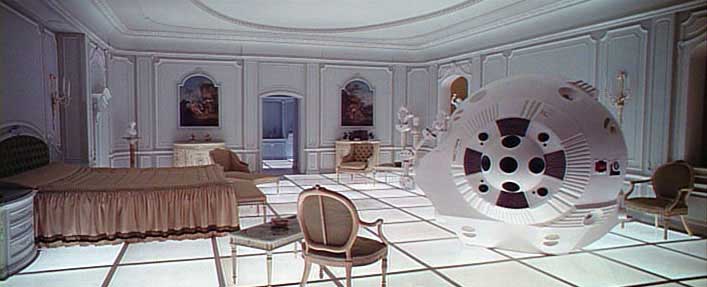
An image from 2001: A Space Odyssey