Sunday, October 28, 2007

Today: A sentimental comedy and startling war film.

Dan in Real Life

Dan in Real Life is a typical Hollywood, sentimental comedy, but it's funny and enjoyable enough to merit a recommendation. Steve Carell gives yet another funny, likable and relatable role where he does very well. He mixes the dramatic and comedic moments without being too slapstick or too sentimentally cloying. He does succeeds in having very good chemistry with Juliette Binoche and the three actresses playing his daughters, all of whom provide nice work. Meanwhile, Dane Cook, who I have not seen in anything beforehand, provides a tolerable performance. Emily Blunt is also fun in a small role.

Peter Hedges's screenplay is smart and funny without going into the "offend everyone" root, although there are times when he puts some cliches in the film, that we have seen time and time before. Nonetheless, it's a nice way to spend an hour and a half.


Full Metal Jacket

Stanley Kubrick was known as an original filmmaker, always tapping into areas in ways different than what other people attempted. With Full Metal Jacket, Kubrick went with the familiar: The Vietnam War, a subject tackled time and time again in other films (most notably Oliver Stone's terrific semi-autobiography Platoon). However, Kubrick unfortunately does nothing to set this film apart from the others, which is why this ranks as his weakest films. That doesn't stop it from being a very well made film.

The best moments in the film come in the first act, as we see many men prepare for the harshness of war, yet one goes over-board. R. Lee Ermey and Vincent D'Onofrio play off each other very well, with one transforming the other. With the Gomer Pyle character, Kubrick gives the character a similar change to somebody in one of his previous films: Alex in A Clockwork Orange. However, while Alex goes from wicked to harmless, Pyle exhibits the opposite effect, with Ermey and soaps wrapped in towels playing the role of his Ludovico technique. D'Onofrio goes into a transformation showing how the army changes harmless "maggots" into killing machines. It's a scary thought that Kubrick brings forth in the film.

After that thrilling segment, the film enters into ironically as one character mentions, "Vietnam: The Movie." The film feels very much like Platoon with Matthew Modine acting a bit like the Charlie Sheen character in that film. Not the say the next two acts aren't exciting, as they continue to show Kubrick's great directing and writing skills, but the familiarity ruins the fun a bit. And each soldier feels like just another soldier with an interesting nickname.

Despite all of that, Full Metal Jacket still proves to be a winning entry in Kubrick's impressive filmography and a film people should certainly see.

Saturday, October 27, 2007

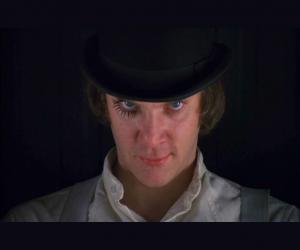
Stanley Kubrick's A Clockwork Orange (1971)

Contains some spoilers

Stanley Kubrick's brilliant adaptation of Anthony Burgess's terrific book is more than just a violent, disturbing, shocking science-fiction film. A Clockwork Orange is a critique on not only disturbed youth, but also the government who tries to take away their freedom of choices. Malcolm McDowell's performance is able to bring these critiques out even more with his transformation. At the beginning, his character of Alex performs horrific acts of "ultra-violence" and rape. He's unlikable and we wait for him to get what he deserves. Later, when a governmental brainwashing experiment takes away his ability to choose, we have a change of heart. A character who the audience hates at the beginning soon feels sorry for him. Alex's change is portrayed perfectly by McDowell, who goes from a sadistic meanie to just a young lad who can't defend himself.

The language of "nadsat" is transfered very well from the book with Kubrick keeping it intact and not distorting it. His use of classical music also works well with the film with the original score giving ample support to the scene. From the opening shot of Alex looking into the camera, to the end ("I was cured alright"), we're fascinated from start to finish. Despite the omission of the final chapter, Kubrick still keeps Burgess's original story, while adding his own feel as only he can.

Wednesday, October 24, 2007

Stanley Kubrick's Eyes Wide Shut (1999)

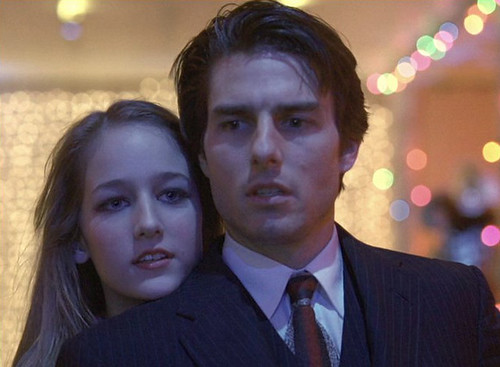
Stanley Kubrick's final film is such a perfect way to end such a brilliant a career. His use of visual imagery comes into perfect use here, as everything from the lighting to the cinematography is top-notch. Also of note is the music which almost feels like a heart beat, showing the viewer how hard Dr Hartford's heart is pumping at those moments. Tom Cruise's terrific performance also helps things, where he's able to make us see plenty by looking at his eyes. A man consumed by his wife's recent revelation, we see that it can lead him to do anything, including attending a masked orgy. Nicole Kidman isn't in the film as much as Cruise, but she provides great work, delivering monologue after monologue with perfection. Of course, who but Kubrick and his numerous takes could manage to do it? Eyes Wide Shut is not such a study on sex, but also a story that unravels at every turn, as every plot detail becomes unraveled for not such the viewer, but Dr Hartford as well.

Monday, October 22, 2007

Dreamgirls (2006)

While other recent film musicals like The Producers, Chicago and Moulin Rouge lost none of their impact when brought to home video, Dreamgirls suffers when shown on a smaller medium. In the cinema, it felt like a full-blown Broadway musical with some terrific songs and star-making performances. On the small screen, all of these are greatly reduced and the flaws become more evident. The most notable comes from the songs. While the music is still catchy, the lyrics are too sappy and sound like the song writer did them in his sleep. Jennifer Hudson's award-winning performance also loses it's grandeur and goes from "surprisingly great" to "rather good."

However, there are still things that don't change in the transition. Eddie Murphy manages to show his dramatic side with a wonderful performance as a man whose life continues to be stepped down and soon goes down a bad path. The dance numbers still retain their energy and Bill Condon's direction still works very well, although his script doesn't. Finally, the art direction, costumes, editing, photography and lighting still hold their Broadway-style feel. The film is still very good, but unlike those previously mentioned musicals, just hasn't made a good translation from projection to digital video disc.

Stanley Kubrick's The Shining (1980)

Stanley Kubrick's The Shining is more than just a horror film. The Shining is a psychological case study on the effects of isolation on the human mind. Kubrick and Jack Nicholson show on screen as the main character slowly descends into madness and soon sees ghosts, particularly a Mr Grady a former caretaker at the hotel, who presents with grotesque ideas of what to do with the family. Jack's son, Danny, also has an imaginary friend, who warns him of impending danger, unlike Grady who leads Jack into creating danger. In this, Kubrick provides an interest contrast: the innocence of childhood and the need to protect it and the madness of adulthood. It is quite possible that Danny could be very traumatised by the events at the Overlook Hotel and could one day end up like his father.

The creepy atmosphere that Kubrick brings to the set, adds to the film's scariness and watching the film again, we instantly recognise (in one scene where Jack and his wife are shown the hotel) locations that we will play a major role later on in the transition Jack goes through. The film's score, with it's twanging violins and eerie notes also make the film all the more creepy. If there's a sour note in the film, it's Shelley Duvall, playing Jack's wife. Throughout the whole film, it's obvious she's "acting" and not doing a good job at it either. This is made even more obvious in "bash your brains in" scene where she confronts Jack. On one end, we get an excellent performance from Nicholson, on the other is Duvall's embarrassing work. Yet, the suspense of the scene is still managed to be saved thanks to Kubrick's direction.

The Shining is a film that much like Kubrick's other works, is a fascinating study on human behavior, while also being a visual splendor and incredibly entertaining.

Sunday, October 21, 2007

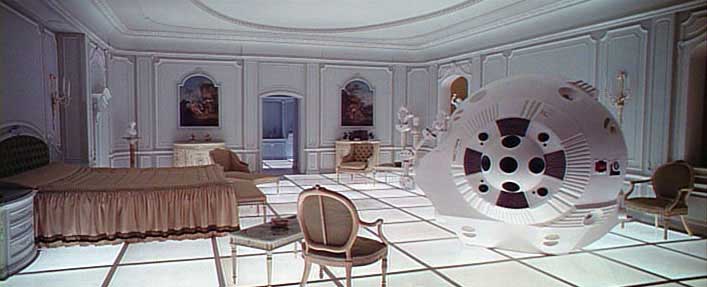
Stanley Kubrick's 2001: A Space Odyssey (1968)

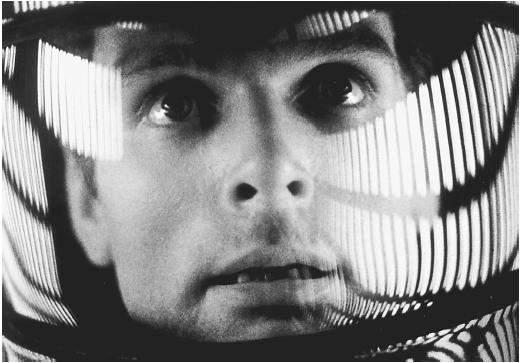
An absolute marvel of a motion picture, 2001: A Space Odyssey defines not on the science-fiction genre, but also cinema as a whole. Stanley Kubrick doesn't rush things and thus gives us a realistic view of space, free of speech and full of wonderment. His use of a classical score only adds even more to the calmness of these opening scenes in space. The film's imagery is absolutely enchanting to watch, with special effects that help the film rather than distract. Despite the film taking place six years ago, 2001 still holds up extremely well.

Yet, despite the film's optimism on space travel in the future, there is also a right amount of pessimism to make it work just right. Probably, the most interesting character in the whole film is the HAL 9000, the computer who suffers a mental breakdown on board. It shows an error that occurs when people try to give computers human feelings, as their control of everything leads them to harm rather than help their creators. Yet, even after his wrong-doings, HAL still displays his calm side. It is not surprise that each letter in HAL's name come right before the letters 'IBM.'

The whole idea of imagery is explored very well in the opening 'Dawn of Man' sequence when the apemen find the monolith. Soon afterwards, they develop a rather violent nature, Kubrick implying that violence is not something we know and do at birth but something we learn and are familiar later on. Similar to HAL, who starts off just knowing a solitary sound and then more information is put in him and like the apes, he learns how to harm and kill.

2001 is a film that can be talked about many times over (and it has) and that is another reason why it's such a masterpiece: The fact that it still holds up as a powerful and beautiful film today. And people are still talking about the ideas that Kubrick and Arthur C. Clarke implanted into the film.

But, if you're looking for a different interpretation...


Saturday, October 20, 2007

A relaxing character study and a fun family film.

Lost in Translation

Lost in Translation has been accused as being boring and slow-moving by some people. I was one of those people, until I watched it again for the first time in four years.

Its slow pace is probably one of the film's best qualities. It's soothing and relaxing, like a nice spa and allows the viewer to get into the two protagonist's lives, as we see both of them suffering from similar problems. Bill Murray, in his best performance to date, gives Bob Harris a calmness as he tries to do with the new, unusual world he's in. There is also humour throughout that makes the character a fun fellow. Scarlett Johansson's performance is also of note as, like Murray, she gives the character a touching edge. Sofia Coppola's direction and screenplay also help in the above cases.

Lost in Translation can be best described as a light film, adrift with few cliches and a believable friendship between two individuals, who despite at different stations in life, are both experiencing similar epiphanies.

Mousehunt

A fun family film, Mousehunt doesn't care about realism (as this film has barely any), but to get the viewer to laugh. And it certainly succeeds in that area. Nathan Lane and Lee Evans make a great team and while they don't put the combination of Lane and Matthew Broderick to shame, they still work very well together. The special effects used to create the mouse are also very well done, as they successfully mix real mice, puppets and CGI. Alan Silvestri's score is also one that adds the fun and darkness to the film, with both his main memorable theme and the sentimental music, too. This is a fun film that allows the viewer to escape reality for an hour and half.


Wednesday, October 17, 2007

Godard's Week End (1967) and Tarantino's Kill Bill Vol, 1 (2003)

Quite a departure from my first Jean-Luc Godard film, Bande a part, Week End is quite an odd, little piece of work. The film does have plenty to admire. The film knows that it is obnoxious and almost self-indulgent and it is not afraid to say it, which is actually one of the reasons it starts out fairly well. One long scene which just simply shows a rather large traffic jam, left me surprisingly more enthralled than bored for some reason. The way Godard directed the sequence really made me want to see how it would progress.

Around the one-hour mark is when the film starts to run into problems. Suddenly, the film loses the self-knowing feeling that made the first part rather good. Godard packs a whole bunch of ideas that ultimately goes nowhere and we're left in the end with a messy film.


Certainly one of the most interesting things that can be said about Quentin Tarantino's Kill Bill is that is probably his most feel-good film. Whether it's the fact that he makes us feel for the lead character or Uma Thurman's rather emotional performance, we have a smile on our face throughout most of the running time. Any reason is that the film doesn't take itself too seriously. The violence and blood is so over-the-top and comically done, that instead of being shocked, we laugh. Tarantino's ability to write great dialogue also adds to the fun of the film. In fact, due to my recent watchings of East Asian films, I appreciate the film even more for its homage to those types of films. And that includes liking Chiaki Kuriyama's performance even more, due to my recent viewing of her work in Battle Royale. It's a fun film that despite its open ending works very well.

The Kid (1921)


Charles Chaplin is, in my opinion, the funniest comedian and the greatest director who ever lived. From his quiet days of trying to cross a street in Venice, California to poking fun at the most evil man in the world, he was a brilliant genius. However, he had his low points too. His first child died three days after he was bored and that hurt Chaplin very much. That terrible incident would later become the inspiration to make one of his most touching films, The Kid which would go on to become one of his biggest hits and make Jackie Coogan one of the first Hollywood child stars.

After a poor mother (Edna Purviance) gives birth to an un-wanted baby (Baby Hathaway), she puts him in a car. Soon, the car is stolen by two criminals who later see the baby and leave him on ground. The Tramp (Charles Chaplin) later appears and finds the baby. At first, he wants to get rid of him, but then changes his mind and decides to raise him as his own. Five Years later, the boy's mother has now become a successful opera singer, but still can't keep her lost child out of her mind. Meanwhile, the Kid (Jackie Coogan) has now become a partner-in-crime with the Tramp. However, when the boy then becomes sick, the authorities take him away. This later leads to a very sad and beautiful ending which we all know Chaplin was famous for.

Charlie Chaplin's most personal feature, The Kid is a wonderfully directed comedy that is a must-see for anyone of any age who wants to check out Chaplin for the first time. Charlie may have gotten top billing, but it's Jackie Coogan's brilliant work as the Kid that should be watched. Coogan gives the best performance ever by an child actor that I have seen. The gags are wonderfully constructed, especially in scenes with the Tramp and the Kid together.

Tuesday, October 16, 2007

Hana-bi (1997)


Most people will refer to Hana-bi as a boring film and I understand where they're coming from, but I felt this was more a relaxing film than a boring one. The visual qualities of the cinematography and Joe Hisaishi's great score allows for a calm, soothing experience like drinking a fine cup of tea. Beat Takashi's performance is also one of praise as he gives a subtle, nuanced performance and very different from the last role I saw him give in Battle Royale. He reminded me quite a bit like Marcello
Mastroanni. In fact, I would not be surprised if he was inspired by Fellini's 8 1/2, as the influence is certainly there. There were many times when I felt the film could have certainly hurried up, but I was still quite a bit impressed with the film.

City Lights (1931)

City Lights

I am not ashamed to admit that I cried during City Lights, both of emotion and of laughter. It's a heartwarming story and it's easy to see why the American Film Institute chose this film to represent the Tramp when they put on their list of greatest screen heroes. Chaplin is wonderful and has great chemistry with Cherrill, even though the two didn't exactly have the best off-screen relationship. The scenes with the millionaire provide the humour very well with both actors playing off each incredibly. However, what really sells the film is the ending, which in my opinion is the best finale in all of cinema history. It seriously is a knockout.

Monday, October 15, 2007

Fritz Lang Double Bill

You Only Live Once
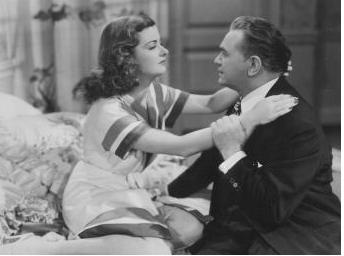
A rather average film from German Expressionist Fritz Lang, You Only Live Once suffers because it just runs too long and adds an additional plot that goes nowhere. However, this is more the fault of the screenwriter than Lang, who uses cinematography and lighting as only somebody with such a background could (see image above for example). The actors are rather good and there are moments of suspense, but it's an overall disappointing film.

Scarlet Street

Fairing much better is Lang's Scarlett Street. A very entertaining film with Edward G Robinson giving an excellent performance as a tormented man who might soon go too far. The script is both funny and suspenseful and has you interested from start to finish. There is a long period of time when Robinson is not on-screen, but that doesn't diminish those scenes. Certainly a classic film to see.

Mulholland Drive (2001)

David Lynch is renowned for his rather odd films. Mulholland Drive is the second of his films I've seen and the first of his so-called odd films. It certainly fits the bill. There is a recognisable story hidden in the film somewhere, but it's the secondary story that proves the most fascinating. Justin Thoreaux provides the film's best performance as a director, who might even be inspired by Lynch himself. His story also proves more interesting than the main one with Naomi Watts giving a surprisingly flat performance. However, as the third act arrives, she improves quite a bit, which begs the question: Was what we just saw a dream or is what we're watching now a dream. It comes so abruptly that I wouldn't be surprised that were the case. However, I would not be surprised if that wasn't.

The film does suffer from problems of running too long and taking a while of getting to the point Lynch is trying to make. As stated before, Watts is rather poor, speaking her lines like a secondary school student. Although, she does improve slightly in the third act. Ann Herring (pictured right) is also rather poor, but unlike Watts, she doesn't improve. Lynch's script also proves flat in parts, but as the film concludes, the film feels more worthwhile as a whole. Although, that's not to say I'm used to Lynch's oddness, because I'm certainly not.

Sunday, October 14, 2007

Fulltime Killer (2001)

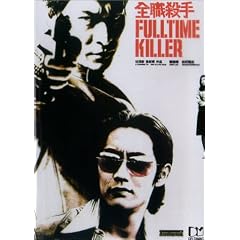
A high-energy Chinese film, Fulltime Killer features Andy Lau in yet another great performance. There are times when the film gets a tad bit ridiculous (and oddly enough, one such moment was inspired by Terminator 2), but the action is well directed. There are the typical melodramatic montages that typically plague Chinese films, but there as common in this film as they were in, say, Infernal Affairs.

Overall, this is a fun film with quite an ending that sure comes out of left field.

...And now the trailer for your enjoyment.


Saturday, October 13, 2007

Magnolia Trailer

An excellent trailer edited by Paul Thomas Anderson with music by Aimee Mann.

Magnolia (1999)

Re-watch: Magnolia - 10/10

The most powerful films are the ones that make you think and be entertained. They are the ones that once you finish them, you will immediately want to see them all over again. They are the ones that make you sit there even an hour after the end credits have rolled and you continue to wonder about the meanings behind such an impressive work of art. No other film comes close to defining those sentences as much as Paul Thomas Anderson's reviting multi-character drama Magnolia. While watching Magnolia (and even after), I was enthralled, entranced and began to view life is a different way. Watching Magnolia is an experience I will never forget, as every time I watch it, my self-esteem gets even higher and the world around me feels completely different. A walk in the park does not feel the same way after watching Magnolia. And I am certainly not able to watch rain pouring down from the sky without thinking that something bigger will happen. This is the effect that Magnolia has had on me.

Magnolia interwines many characters and situations into one day and there is not a single chink in how Anderson writes and directs these chains. Earl Partridge (Jason Robards) is a television producer, dying from cancer and whose only support along with his machine are his nurse Phil (Phillip Seymour Hoffman) and much younger wife Linda (Julianne Moore). His final dying wish is to see the son who he left many years before with his ex-wife. His son, Frank T.J. Mackey (Tom Cruise) is now a motivator for men and keeps his past safely hidden from public view. Meanwhile, the game show host of 'What Do Kids Knows?', Jimmy Gator (Philip Baker Hall) is growing fainter and fainter and his drug-addicted daughter Claudia (Melora Waters) becomes the object of affection of kind policeman Jim Kurring (John C. Reilly). The current game show champ, Stanley Spector (Jeremy Blackman) has problems with his money obsessed father and after an accident occurs on air, he has had enough. The former game show champ Donnie Smith (William H. Macy), now with none of his winnings attempts to get a local bartender to fall in love with him, even if it means falling towards crime. This description of Magnolia's events are not even enough to give the film justice as it has to be seen to get the whole story. Merely reading a plot summary won't do anything.

If Paul Thomas Anderson's only film was Magnolia, that would still make him the best filmmaker of my generation. While other serious filmmakers try to make films either to homage previous works (Quentin Tarantino), add some more awards to their shelves (Clint Eastwood) or receive a lot of money (Peter Jackson), Anderson instead makes films that have some more spice and meaning than what can be found today at the local 20-screen, stadium seat multiplex. When he makes a scene in which all of the characters sing to Aimee Mann's "Wise Up", it's not just because it's "cool", but because he's talking about how even though people will feel something different than somebody else, there's still something makes them the same and connectible. In fact, the use of Aimee Mann's songs, particularly her magnum opus "One" which opens the picture and through which we are introduced to each and every character, is pure genius on Anderson's part as he allows even the music to express the character's feeling. The actors work along with the score to provide an very soothing experience. Despite the film's three hour length, not once do you feel like your bottom is aching like it would while watching a bloated epic. You're amazed by the imagery presented on screen and the way the story cuts back and forth between everyone.

The actors play a major part in Magnolia as well. Tom Cruise gives quite possibly the work that he will not surpass for many years, as unlike his other performances, we actually truly care about the character, despite him being written as a sexist snob. The relationship between Claudia and Kurring are portrayed perfectly and very realistically by Melora Waters and John C Reilly, who provide real awkwardness to the conversations that Anderson has provided them to speak. The crowning performance of the film is, without a doubt, Philip Seymour Hoffman's subtle and heartbreaking work as Phil the nurse. We see the character's feelings through his eyes and mannerisms. He is the only sane person in this world full of bizarre individuals and his struggle could not have been shown better by another actor. Yet, past the music, the cinematography, the editing and the performances, the man who is the most responsible for Magnolia's brilliance and its immediate entry into the hall of American motion picture classics is Paul Thomas Anderson. Magnolia is his almighty gift of forgiveness to the world and boy, it is quite a fantastic effort to be sure. Magnolia is like a massage and even while writing this review, I still feel it juicing my brain and allowing to think and know that film is the most important and most powerful medium ever created. I thank thee, Mr. Anderson, for this brilliant masterpiece of a film.

Now, check out the trailer which can be watched on the blog entry above.

First Post ! :-)

This is my first post on this new blog, where I will post my thoughts of a film every time I watch one, whether it's the first viewing or not. Comments are appreciated, but please be civil (although I do accept negative comments, please don't go overboard. And no off-topic comments, as well.

Well, enjoy the blog!

Thank you for reading!

Thank you for reading!
An image from 2001: A Space Odyssey