Showing posts with label Stanley Kubrick. Show all posts

Thursday, January 10, 2008

My Top Ten of the 21st Century

1. The Producers (2005, Susan Stroman)


Hilarious, bold, brilliant. Mel Brooks's classic Broadway musical is finely turned into a terrific motion picture adaptation by stage director Susan Stroman. The cast is in perfect form, particulary Nathan Lane who plays the sad-sack producer Max Bialystock with the right amount of humour and pathos. Matthew Broderick gives Leo Bloom a nice sense of innocence, even while pulling off the ultimate scheme. Uma Thurman, Will Ferrell, Gary Beach and Roger Bart also pulls off their parts brilliantly. Coupled with fantastic songs, amazing song-and-dance numbers and a show-within-a-film that has to be seen to be believed, The Producers is without a doubt the best film of the decade.

2. Spirited Away (2001, Hayao Miyasaki)


Quite possibly the best animated film of all-time, Hayao Miyasaki fills this wonderous story full of beautiful colour and fantastic characters. The main character of Chihiro is an independent young girl, who tries to make it in this world, and even though she's a drawing, Miyasaki makes her feel like a real personality. Joe Hisaishi's score combined with Ghibli's animation (probably the best animation unit in the world) created a seamless blend of perfection that only Disney can even come close to.

3. The Lord of the Rings: The Return of the King (2003, Peter Jackson)


A incredibly epic adventure and a brilliant conclusion to a very good trilogy, The Return of the King is amazing entertainment from start to finish. Its three hour running time doesn't hinder the film in the least. Everybody in the cast succeeds, particularly Andy Serkis as Gollum and Ian McKellen as Gandalf. The special effects are absolutely brilliant and the best of the modern film era. A compelling story, this is Peter Jackson's finest hour (make that three hours). It may just be about people walking to a fucking volcano, but hell, I enjoy it a lot.

4. Capote (2005, Bennet Miller)


A pitch-perfect performance from Philip Seymour Hoffman helps make this film more than just your typical "true story." He embodies Truman Capote, not just doing an impersonation, but actually transforming into the neurotic author of In Cold Blood. Bennett Miller's only other previous credit is of a documentary and that is quite evident with his direction here. The film feels real, like we're watching Capote at work and not necessarily Hoffman at work. Dan Futterman's screenplay shows the pains that can happen when writing a real figure and how far a man can go for a book, even if it destroys him. Catherine Keener also does some great work as Harper Lee with the other big actor of the picture, Clifton Collins Jr, giving a chilling and intense performance as the infamous Perry Smith. Slow and calculating, Capote is already a classic in my eyes.

5. The Royal Tenenbaums (2001, Wes Anderson)


Wes Anderson's very funny character study on the family unit, this isn't just another film about a dysfunctional and quirky family. This is a comedy that brings upon the idea of how one major event (whether true or not) can bring them together. Filled with an impressive ensemble cast, a clever screenplay, an un-pretentious direction and a splendid soundtrack, this is a film that is both very entertaining but also causes one to think about how family is important. Godard would be proud.

6. The Departed (2006, Martin Scorsese)


An example of an American remake that can be miles above the Oriental original film, The Departed is an intense thriller that isn't afraid to pack any punches. Martin Scorsese's direction is perfect and despite taking place in Boston, his New York intellect is still intact. William Monahan's screenplay may be profanity-laced, but it's perfect to boot with its odes to Shakespeare sprinkled throughout and wonderful to spot and one of the best endings in years. Plus, there's DiCaprio, Damon, Nicholson, Wahlberg, Sheen, Baldwin, Winstone, Farminga. Who could ask for a better cast?

7. Stanley Kubrick: A Life in Pictures (2001, Jan Harlan)


A fascinating and well edited look at the impressive career of filmmaker Stanley Kubrick, this documentary is not just a smattering of praise. It looks deep into what made his films so interesting as well as the persona he kept so hidden from the public. Jan Harlan (the film's director), Malcolm McDowell, Woody Allen, Steven Spielberg, Christiane Kubrick and a batch of other interesting interviewees supply plenty of thoughts on Kubrick himself as well as his films. This is a special documentary that should be seen by any Kubrick fan. It's that essential.

8. The Last Shot (2004, Jeff Nathanson)


Featuring two fantastic lead performances and a hilarious screenplay, The Last Shot is un under-rated gem. Matthew Broderick is perfect as Steven Schats, an aspiring director. He fills him with enthusiasm, creating an incredibly relatable character. In fact, this character reminds me so much of myself, it's insane. Alec Baldwin also does incredible work as the under-cover FBI agent posing as a film producer. He adds plenty of warmth to his performance, instead of going for a tough guy routine that other actors might have given him. Baldwin is touching and his chemistry with Broderick is pitch-perfect. Toni Collette, Tony Shalhoub, Joan Cusack and James Rebhorn also do some fine work in their smaller roles. Jeff Nathanson's screenplay captures the wide-eyed wonder of Hollywood terrifically, bringing plenty of hilarious one-liners and jokes. This certainly stands as one of the best of the decade so far.

9. The Dreamers (2003, Bernardo Bertolucci)


Bernardo Bertulocci takes an erotic angle on the minds of film aficionados with this well-roven drama of an American teenager and the two French twins he befriends in Paris during the period of the Student Revolution. Eva Green gives a perfect performance as the lead female as she blends naturally into the part. Michael Pitt and Louis Garrel do fine work as the other two leads (though they're no match for Green). An essential for any film fan, this is also educational as it talks about an important historical event and could even lead some people to watch some Chaplin, Keaton and Godard as well.

10. Catch Me If You Can (2002, Steven Spielberg)


Yet another terrific film from Steven "The Man" Spielberg, Catch Me If You Can is a fun journey through the world of a young man doing every person's dream. Leonardo DiCaprio plays Frank Abagnale, Jr. with a charm that echoes Johnny Depp and Matthew Broderick, among others. And in the film's more dramatic moments, he delivers just as well. I would probably say this is my favourite DiCaprio performance. Tom Hanks, Christopher Walken and Amy Adams also do fine work in their roles. Everything else is top-notch as well. The screenplay, the cinematography, the costumes, the soundtracks, the art direction, the editing and of course, Stevie's direction. Incredible that even at 60 years old, it seems as if Spielberg hasn't gotten older (though he's certainly matured).

Honorable Mention: Match Point (2005, Woody Allen)


For many years, Woody Allen shot his films in New York, showing neurotic characters discussing that they "would never want to belong to any club that would have someone like me for a member", quoting the old Groucho Marx quote. With Match Point, the clarinet-playing, Marx-quoting Allen moved to a totally different city: London, England. And thus, there is a change of pace from nervous, neurotic individuals to confident people looking to climb the social ladder. As typically happens when an American filmmaker puts his lens on Britain, audiences are treated to the upper-crust of English society and for Match Point, it works. Match Point also lacks the feel of a Woody Allen film, which makes it even more fascinating as he allows the actors to work on their terms, reading his written lines with enough of their own feel. And particularly what sets this film apart from previous Woody fare is the darkness of the production. While he has tackled dark films before with the Bergman-inspired Interiors and Crimes and Misdeamenors (which this film borrows heavily from), never has he attempted to make a psychological thriller. Match Point isn't like, say, The Silence of the Lambs, but it does have a suspenseful feel lurking around it.

Friday, December 21, 2007

A great adventure story: Jurassic Park (1993)

Sure, the acting isn't perfect (except for Jeff Goldblum) and there are some un-interesting stretches when there isn't any dino action, but Jurassic Park certainly is a bucket-load of fun. Steven Spielberg's direction is splendid as usual, as he brings both warmth, adventure and terror to the film. The special effects are brilliant and still some of the best ever done for a film, with the change from CGI dinosaurs to robotic ones being seamless. The action scenes are very well done too and despite the flaws of the film, Jurassic Park is still very re-watchable.

I also noticed on this viewing that the scene with the Raptors in the kitchen is very similar to the part in The Shining when Jack is chasing Danny around the Overlook Hotel's kitchen. Considering The Shining is one of Spielberg's favourite films, this homage wouldn't surprise me (and Kubrick was a fan of Jurassic Park, himself).

Wednesday, December 12, 2007

DVD Review: Eyes Wide Shut (1999) - Two Disc Special Edition

Warning: The following review of Eyes Wide Shut contains spoilers for the film.

Stanley Kubrick began his career as a teenage photographer and finished it as a maverick filmmaker. The transition from a young Brooklyn kid to one of the greatest directors in the history of film is an impressive one and rather evident in plenty of his films. Kubrick always knew how to frame a shot, ever since he began taking pictures as a boy. In each of his films, the camera was placed perfectly, creating superb picture after picture. Kubrick was not just a filmmaker, he was an artist. Many years from now, his films will be looked at the same way the paint strokes of Goya or the music of Mozart are analysed today. To cap off his incredibly consistent career, the reclusive Kubrick made his first film in twelve years and one of his best. Eyes Wide Shut is a film that is hard to classify into one genre, as its unique cinematic experience brings something different never experienced before. Kubrick would continually re-invent film with such masterpieces like Dr. Strangelove, A Clockwork Orange and most importantly 2001: A Space Odyssey, his magnum opus. Eyes Wide Shut may unfortunately be Kubrick's final film, but thankfully he left the world with a bang and not a whimper.

Bill Harford (Tom Cruise) is a New York doctor whose night of drugged sex goes differently than planned when his wife Alice (Nicole Kidman) reveals that she almost had an affair. Filed with jealousy, he wanders through the city in a sexual odyssey. He encounters street thugs, a kindly prostitute and finally an old pianist friend, who reveals a little too much about his next recital. Moving down to the seedy underworld of the Illuminati, Harford finds himself in the middle of an orgy where the rich come to watch as young maidens de-flower themselves in front of everyone. After the scare of his life, the curious doctor decides to investigate the meaning behind the night's events and like the viewer, he is not sure whether or not he should believe what is given to him.

Like all of Stanley Kubrick's films, Eyes Wide Shut is a piece of work that gets better with multiple viewings and more is noticed with each look. Not surprisingly, there is still plenty left un-explained and like a detective story, the viewer has to unravel clues much like the main protagonist does. Yet, before Harford turns into Sherlock Holmes, he represents a modern version of Odysseus from Homer's The Odyssey. Throughout the film, he is confronted by individuals wishing to give him sexual pleasure, yet he avoids them much like Odysseus and his encounter with the sirens. Similar to that character, turning down the various characters turned out to be fortunate for him. During his dreamy walk through New York, Harford encounters a prostitute who he kisses but eventually does not sleep with. The next morning, he finds out that she is HIV-positive. His decision to not have sex with her turns out to be a good one as he does not receive the deadly disease. He also turns down the offer of a patient of his and despite his sexuality being questioned by a group of rowdy teenagers (thus leading to the encounter with the prostitute), he still does not cheat on his wife. Her words may have caused jealousy, yet he actually ends up being a more noble character than Alice. With Harford as his main protagonist, Kubrick actually brought upon a rare personality that for him was un-explored. Harford has his flaws, but he is actually the most sane character of the film and the least demonic. Tom Cruise's performance also helps the audience be with the character as goes on his journey. He gives life to Harford and fleshes him out into a human being with feelings and emotions. Cruise is an accomplished actor and he hits the right keys, not going over-the-top and not being too drone-like. It is a subtle performance from one of Hollywood's biggest stars.

Stanley Kubrick would always give his female leads as much as heart-ache as his lead male actors. Most of the time he managed to bring forth a great performance as evidenced by Marisa Berenson in Barry Lyndon and Sue Lyon in Lolita. In the case of Shelley Duvall in The Shining, there was the opposite effect. Thankfully, Nicole Kidman's work in Eyes Wide Shut proves to be an outstanding performance, bringing forth a character whose dark side is shown even when she's just glancing towards the camera (a frequent Kubrick trademark). Her character is not on screen as much as Cruise is, but when she does show up on camera, she excels. Most of Alice's dialogue consists of monologues, each showing the character's rough edges easily. Kidman perfectly brings layer upon layer on the character. Even in Harford's frequent fantasies, there is something sinister and careless told about her. The most fascinating scene of Kidman's comes when she is high on drugs and reveals her sensual theories to her husband. The combination of Cruise and Kidman starts the scene, but she soon takes over silencing not just Harford but the viewer as well.

Another possibly sinister character with something to hide is done very well with Sydney Pollack. As soon as he is shown in a bathroom with an over-dosed and naked girl, the audience knows that this man has a couple of skeletons in his closet. When he reveals to Harford some information regarding both the cult and the naked girl, both Harford and the viewer aren't quite sure whether to trust him or not. It's not just the screenplay that leads us to believe this, but Pollack's performance as well. That final scene either produces plenty of information or makes people more confused about the past two hours than they were before. He says the whole orgy cult was done to scare Harford, yet why would they go through all the trouble to do all that? Harford is suspicious and so are we.

Kubrick only follows that sequence up with a final confrontation between Bill and Alice. In these culminating scenes, Alice states that "only as sure as I am that the reality of one night, let alone that of a whole lifetime, can ever be the whole truth." All of this goes back to the film's title. Are Harford's eyes wide shut? Or could it be Alice or even the pianist? How about Sydney Pollack's character? For all we know, it could even be Kubrick himself as the director certainly did work in mysterious ways. It is rumoured that long-gone rapper Tupac hinted in his songs about his eventual death. Could it be that Kubrick wanted to give us one last hint about him in this film? It is possible that we will never know. Yet, he left behind a treasury of classics and Eyes Wide Shut most certainly ranks among his best.

Now, Eyes Wide Shut has finally gotten the two-disc special edition treatment it so rightfully deserves. The transfer is terrific and the collection of extras, both new and old, is great. The first extra, on Disc Two, is a documentary called The Last Movie: Stanley Kubrick and Eyes Wide Shut, which takes a look at Kubrick's final years, including the production of Eyes Wide Shut. It's an interesting featurette, although I would have liked to see more information on the title film. There's yet another featurette right afterwords that looks at the films that Kubrick almost made, most well known of which were his Napoleon and Holocaust projects. It's the best supplement on the set and does an interesting job at showing the way Kubrick worked. This is followed by his speech from when the famed filmmaker won the Honorary Director's Guild award shortly before his death. Kubrick never did many public filmed interviews, so this is a treat to watch.

Finally, the disc ends with some extras taken from the previous DVD release of the film. There is an interview gallery consisting of conversations from Cruise, Kidman and Kubrick's long-time friend, Steven Spielberg. Spielberg provides the most interesting discussion as he talks about the power of Kubrick's films as well as his friendship with the man. Cruise and Kidman also provide a couple of interesting comments, but it's mostly just praise (and since they were recorded before their divorce, their discussions are also rather dated). The last extras are a series of trailers for Eyes Wide Shut. Probably what will please all North American Kubrick fans is the first Region 1 release of the uncut version of Eyes Wide Shut, never before released in that part of the world. This is the way the film was intended to be seen and thankfully newcomers of the films will only be able to watch this version.

Stanley Kubrick's Eyes Wide Shut is a phenomenal motion picture and one that has incredibly re-watchability value as each viewing brings forth something new. Like Kubrick's other films, this is a art work and one that can be theorised for many years. This DVD is definitely worth adding to any collection.

Note: The film can also be purchased with the new Stanley Kubrick Directors Series box-set, which also has two-disc editions of 2001: A Space Odyssey, The Shining and A Clockwork Orange, as well as single discs of Full Metal Jacket and the documentary Stanley Kubrick: A Life in Pictures. If you're a Kubrick fan, the box-set is definitely worth getting, especially for its bargain price of about 60 to 80 dollars.

Friday, November 16, 2007

DVD Review: A Clockwork Orange (1971) - Two Disc Special Edition

Stanley Kubrick was a filmmaker who continually tried to both shock and amaze his audience, but most importantly he wanted people to come back again and again to unlock the layers of secrets hidden beneath his films. Plenty has been told regarding the impact of his A Clockwork Orange upon its original release, yet even looking at the film in it's own terms, it's easy to see why it's regarded as such a masterpiece. Kubrick adapted Anthony Burgess's equally brilliant book rather faithfully, but still giving the film his own mark. His films have been criticised for being cold and heartless, yet it's almost necessary for A Clockwork Orange to be filmed in such a style. Kubrick portrays his near-future as bleak and lacking the Utopian feel that most science-fiction writers were predicting. Reading the headlines in today's newspaper, the futuristic world depicted in A Clockwork Orange has unfortunately come true. This goes both for the portrayal of youthful aggression as well as the government's attempts to rid the world of it.

Teenage violence at its worst is personified in the lead character of A Clockwork Orange, Alex DeLarge (Malcolm McDowell). Alex is a parent's worst nightmare: He is cruel, violent, cold-blooded, but filled with intelligence, which he unfortunately does not put to better use. Alex romps around town with his gang of "droogs", raping and hurting innocent individuals just for the fun of it. One of the most disturbing (of many) sequences in the film is the scene in which is rapes a writer's wife while dancing and skipping along to "Singin' in the Rain." A seemingly innocent song about love is used in a means completely the opposite of its original intention, thus why it's such a disturbing part of the film. What's even worse is Alex knows that what he is doing is wrong, but his lack of conscience causes him to not care what society thinks of him and his ideas of fun. Kubrick's uncanny ability to seemingly combine beautiful classical music to a montage of horrifying comes into play in A Clockwork Orange, with Alex's admiration towards the works of "Ludwig van." Beethoven Ninth Symphony is turned from a wonderful piece of music to something particularly saddening as we learn how much this sadistic rapist obsesses over it and "As I slooshied, I knew such lovely pictures!" These so-called "lovely pictures" which contain such R-rated material as rape, violence and blood pouring out of Alex's fangs would probably scare Beethoven due to the way Kubrick so perfectly edits the images together.

Yet, there comes an interesting turn-around when Alex is arrested and sent to prison. Soon afterwards, the tone of the film completely changes as Alex begins to play nice and the film becomes far less disturbing and chaotic than the first act was. Alex wants to get back out into the world as quickly as possible and when he hears of a technique that will help him do so, he jumps to the chance. He is soon put in the Ludovico Technique, involving him being strapped to a chair, his eyes made un-shutable and forced to watch horrible acts of violence on a cinema screen. When Alex's beloved Ninth Symphony begins playing over images of Adolf Hitler and the Nazi Party, it is then that the effects take hold. Even Alex of all people realises that he is an amateur compared to the atrocities the Nazis performed during the Holocaust. This leads to an effect more cruel than the Technique's creators possibly imagined: Not only is Alex drained of violence, but also of his love of fabulous music. Maybe Beethoven heaves a sigh of relief, but us the viewer is oddly starting to feel sorry for Alex. He may be unable to commit violent acts, but he is also unable to choose whether he wants to or not.

Stanley Kubrick launches on these themes perfectly as only he can. Other filmmakers would probably none too subtly through these into the viewer's face, but not Kubrick. Like many of his other films, he allows to slowly tear apart the film throughout multiple viewings and even let us interpret the film's views ourselves without him interfering. He just sits, stroking his beard and thinking "yes, that seems about right. What else do you have to say regarding the film?" Malcolm McDowell's performance also brings us into Alex's world, carefully pronouncing each word that Burgess created for his book so as not to make any mistake. Each subsequent viewing, we learn a new meaning for "nadsat" and see that it is more than just the way Alex communicates, but also a part of his rebellion against the world he tolerates so much of. Stanley Kubrick not only created a masterpiece worthy of plenty of conversation, but also a look at our world currently operates and ways we can resolve these problems without the need of brainwashing techniques.

For this new edition of A Clockwork Orange, Warner Brothers has finally given the film the treatment it fully deserves on DVD, by affording it two sublime discs. The transfer is nice and sharp, with the images looking almost perfect. Meanwhile, the audio is also give a nice boost, particularly in the music-filled scenes, where Beethoven's music is even more clear than before, as are the dialogue between characters and sound effects. On the first disc, in addition to the fast-paced, almost seizure inducing theatrical trailer, is an audio commentary with Malcolm McDowell and film historian Nick Redman. McDowell is always fascinating to listen to and he provides an extremely informative chat on the film with Redman acting as a very good moderator. The second disc begins with a Channel 4 documentary on the controversy surrounding the film's release, with plenty of attention given towards the reaction in England, Kubrick's home for many years. While most of the information provided may not be new to fans who have already read plenty on the reaction towards the film, but they're still some interesting comments in the show to make it a very worthwhile watch.

A second documentary on A Clockwork Orange is provided regarding the film's influence on filmmakers, particularly people like Steven Spielberg, Sydney Pollack and George Lucas. There are also some factoids on the shooting of the film and Kubrick himself. It's yet another great addition to the disc. Finally, the set concludes with a documentary called O Lucky Malcolm!, that looks at the career of the film's lead actor Malcolm McDowell. Running about an hour and a half, the film takes a bit of a look at Clockwork Orange, but it also gives plenty of substantial information regarding his other roles, particularly his frequent collaborations with Lindsay Anderson and his time-travel film Time After Time. While it may have been nice to see more regarding his roles in the 80's and 90's, it still provides plenty of interesting comments on McDowell, the most interesting coming from his family and even himself. This documentary ends the disc very well.

A Clockwork Orange stands as one of Stanley Kubrick's masterpieces and Warner's new two-disc set provides enough good new material and a wonderful new transfer to make it a worthwhile purchase for fans of the film. This disc comes highly recommended.

Note: The film can also be purchased with the new Stanley Kubrick Directors Series box-set, which also has two-disc editions of 2001: A Space Odyssey, The Shining and Eyes Wide Shut, as well as singles discs of Full Metal Jacket and the documentary Stanley Kubrick: A Life in Pictures. If you're a Kubrick fan, the box-set is definitely worth getting, especially for its bargain price of about 60 to 80 dollars.

Thank you for reading!

Thank you for reading!
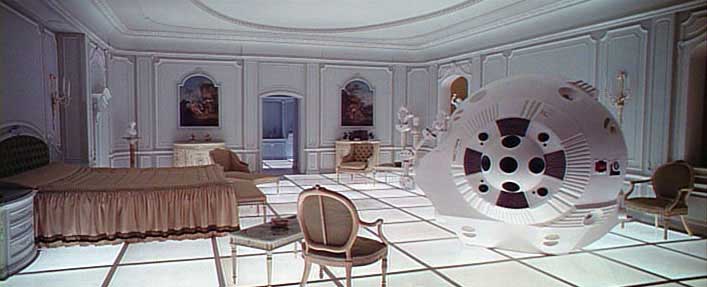
An image from 2001: A Space Odyssey