Showing posts with label animation. Show all posts

Monday, December 17, 2007

A perfect animated musical production: Beauty and the Beast (1991)

It has been said that the pen is mightier than the sword, but when this age-old phrase is converted to modern times, it translates to "the desktop is mightier than the pencil." There's no denying that the computer has become a tool used across the world, whether for political reasons, or for business or especially for educational purposes. Computers have also been adopted by the film industry to give their works of art a shinier feel and along with the visual effects wizards, the filmmakers who use these electronic devices the most are the animators. After a while, it was uncertain whether the cel-based animation used to create such classics like The Little Mermaid and Pinocchio would be completely dropped in favour of the quicker and slicker style. While studios like DreamWorks may have given up on them, the folks at the world's pioneering animation studio are still behind the pencil-and-paper animation that has enchanted families for generations. Looking back at one of their essential works, Beauty and the Beast brings back memories of not only nostalgia, but also warmth. Quite possibly the greatest love story ever told, this "tale as old as time" has always been told by bringing pen to paper. From its candle-lit beginnings by a French writer many years ago to the Disney animators who brought joys to people of all ages, Beauty and the Beast has always touched the heart.

Belle is a smart and independent girl living in a small French town, who despite her beauty, is looked down upon by the other citizens. Only Gaston, the town's ladies man, has any interest in her and will stop at nothing to receive her hand in marriage. When Belle's father rides off to compete in the state fair, he gets lost and finds himself in a mysterious castle, populated by moving and talking objects. Despite a warm welcome, he soon finds himself under the imprisonment of the beast who rules over the castle. Coming to her father's rescue, Belle decides to take his place and stay in the castle. The Beast and the objects finally see this as a chance to break the spell that was cast over them years ago, in which the only way it can be broken is if the beast learns to love and be loved in return. At first, the chances are slim, but Belle then begins to notice the beast's sweet side and thus a friendship commences.

The main part of what makes Beauty and the Beast such a brilliant film is the fact that the relationship between the two title characters doesn't feel artificial or one-dimensional, even though they're drawn on paper. Unlike other famous fairy tales, Beauty and the Beast feels quite realistic in its definition of love. The story breaks all conventions by not going the "love at first sight" route and letting the romance progress at a reasonable pace. Belle also proves to be the most interesting Disney heroine, as she doesn't fit the norm of typical princesses like Snow White and Sleeping Beauty. Unlike the aforementioned characters, Belle is not bland, but actually as a personality. She defines individuality and seeks to do more than just marry a prince. Her annoyance at Gaston is not only humourous, but also shows that her ideas of romance don't consist of "a rustic hunting lodge... my latest kill roasting on the fire... and my little wife, massaging my feet... while the little ones play on the floor with the dogs... we'll have six or seven," as Gaston puts it. The Beast is also a rather stubborn, but loving personality. Despite his tough exterior is a nice person at heart which Belle begins to realise the more into the relationship they enter.

Adding to the brilliance of the chemistry between Beauty and the Beast are the songs from Alan Menken and the late Howard Ashman. Although both did terrific work on The Little Mermaid and their cult musical Little Shop of Horrors, the music in Beauty and the Beast stands as their best. The title theme song is quite possibly one of the most romantic songs ever written, combining beautiful lyrics with a very memorable melody. This song enhances the film's famous ballroom scene to ever impressive heights, already helped by the breathtaking animation in the sequence. "Beauty and the Beast" was not written as just a way to sell soundtracks and win Oscars. It adds another dimension to the characters as they continue to fall deeply in love with each other. It is both moving and deep. The other songs provided by the team also contribute wonderfully to the film, from a show-stopping Broadway number called "Be Our Guest" to the very funny ode to "Gaston." They're bursting with energy and humour made even more poignant by the fact they would feature the last lyrics written by Ashman (who had also already contributed some work to Aladdin). It's a brilliant way to end his career and the end credits homage him perfectly: "To our friend, Howard, who gave a mermaid her voice and a beast his soul, we will be forever grateful. Howard Ashman (1950-1991)"

Probably one of the most important ingredients that make Beauty and the Beast such a success is the startling animation. The animators at Disney did a terrific job at making everything absolutely perfect, from the character designs to the sets. Each character has their feel, whether comedic or dramatic, and the animators allow them to breath, seamlessly combining the actor's voice to the moving drawings. The sets are also worthy of mention, particularly the look of the Beast's castle. The gothic castle is drawn and painted beautifully from top to behind, so much so you're forgetting you're watching an animated film. The film is bright and colourful, but also dark and dreary when necessary. As mentioned before, the ballroom sequence combines Menken and Ashman's music with the animation flawlessly, giving a completely magical feel to it. When computers are brought into the scene, it seams in perfectly, not feeling distracted in the least. Beauty and the Beast most certainly stands as Disney animation at its finest.

Some of the best animated films in the world have come from the Walt Disney studios and Beauty and the Beast is deservedly one of their crown jewels. At the film's release, it was honoured with an Oscar nomination for Best Picture, a rare feat for an animated film. It proves that like its heroine, Beauty and the Beast steps out of the comfort zone and thus it succeeds magically in taking people off into their hearts and children within.

An example of the "beauty"...

Friday, November 23, 2007

Walt Disney's Pinocchio (1940)

For seventy years, people of all demographics have been entertained and enchanted by the animated features brought out by the Disney studios. In an era when most animated films lack imagination and spirit, it's always nice to watch an earlier Disney film, whether it be one of their old classics or the works released during the early 90's renaissance. Most film historians claim that Snow White and Fantasia are the best films to come out of the beginning years and while I agree they are certainly historically important, they don't quite give me the joy provided by 1940's Pinocchio. Adapted from the Italian story, Disney may have changed things plenty during the writing progress, but the result is a magical and unforgettable experience that proves to not only be a fun romp, but also one of the best cautionary tales brought to the screen.

The story is, of course, familiar to everyone. A kindly, old woodcarver named Gepetto builds his own "little wooden boy" and soon enough the puppet is brought to life. However, before he can become a real boy, Pinocchio must prove himself worthy and with Jiminy Cricket as his conscious, he goes out into the real world, full of crooks and criminals. Naturally, Pinocchio the ever youthful puppet, lands into plenty of trouble, first becoming an actor for a scary marionette master and then being turned into a donkey. The audience, especially the young children watching, are absolutely enthralled by the whole production, but also scared by what is shown on screen. Unlike today's cartoons, that try to be as "friendly" as possible, Walt Disney wanted his films to leave an impact and Pinocchio certainly fits into that category. While the film enchants, it also provide plenty of frightening moments as well.

Quite possibly the scariest scene in the film is when on Pleasure Island, troublesome boys are transformed into donkeys and sent to the salt-mines. Pinocchio can quite possibly be called the greatest anti-cigar film ever made, just for the fact that it doesn't say that smoking is bad, it shows it (although, ironically, Disney himself was a massive smoker)! Another scene that really gets to young audiences is the part in which Pinocchio begins to lie up a storm and his nose grows, even producing a nest with birds at the end. It's enough to make children squirm in their seats and have them afraid to tell a lie again. One of the reasons these scenes are so successful in leading people to the right decision is the fact that Pinocchio is not just a little wooden boy, he represents the child in every one of us: naive and ready to set out into the world, but not fully aware of the dangers awaiting us.

Along with the donkey-transformation and nose-growing scenes, the most memorable aspect of Pinocchio is the music. "When You Wish Upon a Star" is Disney's anthem for a reason. It's not only beautiful, but also brings about what we all want: to wish for a better world, one without evil puppet masters, children taking bad habits and devilish foxes bringing people to the dark side. Finally, the most touching scene comes in the end, when Pinocchio seems like he might die, but his bravery to save Gepetto finally allows him to become a real boy. Even remembering that scene leads one to smile as it's not only Gepetto and Pinocchio's wish that is fulfilled, but ours as well. Everybody loves a happy ending and Pinocchio features the best of them all. Not only is it the best film made by Disney, but it's also their most optimistic. And that's why Pinocchio is such a classic.


Sunday, November 11, 2007

The latest animated charmer from DreamWorks Animation is...

There's something about animated insects that seems to attract popular big-city comedians for some reason. New York's Woody Allen lent his familiar voice to Antz with slightly embarrassing results. A couple of months later, Mark Foley, from Toronto's "Kids in the Hall" troupe, played the lead in Pixar's A Bug's Life, succeeding rather well. However, unlike Allen and Foley, both of whom were hired after story completion, DreamWorks' Bee Movie was sitcom star Jerry Seinfeld's project from the very beginning. The film features his usual charm and wit and as is able to succeed without going through the "off-colour adult humour" route that seem to be plague modern animated productions.

Like other animated films about talking bugs, Bee Movie portrays its title heroes as human-like, showing a close-up at the hive and comparing the two different species rather comically. Bees are shown as using honey for hygiene, flying as the equivalent of running and graduating university in a grand total of three days. Barry B. Benson (Jerry Seinfeld), however, is less than enthralled about having the same job for the rest of his life, despite the excitement of his best friend Adam (Matthew Broderick). Barry decides to fly out of the hive and explore the outside world. After being saved by a human florist (Renee Zellweger), he befriends her and soon finds out that humans have been eating honey for decades. In response, Barry sues the human race and the honey factories are shut down. Unfortunately, things don't become as cheery as Barry had planned.

To put it simply, Barry is essentially Jerry Seinfeld in bee form. He constantly tells jokes wondering the reason for certain things and he plays off other characters very well. Zellweger gives an almost Elaine Benes vibe in her performance as the florist and this leads to some humourous moments between her and Barry, creating a relationship almost akin to that of Kermit the Frog and Miss Piggy. The other actors do rather well, too. Matthew Broderick once again plays the straight man and voice-of-reason with a calm feel, while John Goodman puts on a humourous Sourthern accent for his role as an insect-hating lawyer. Seinfeld also rounds up celebrity cameos from Ray Liotta (who is able to lampoon himself with a little help from the animators), Larry King and Sting. Chris Rock also provides the film's funniest line as a blood-starved mosquito.

Bee Movie also proves to be a rather winning social commentary on the legal system and how suing shouldn't necessarily be the answer to everything. There are also some funny jokes on inter-racial marriage and airport regulations. That's for the adults. For the younglings, this film is funny for them as well, mixing colourful animation with some physical comedy and roller-coaster-ride sequences. Harry Gregson-Williams' bouncy score also adds to the charisma and fun of the production. Insect biologists will probably cry fowl regarding the film's inaccuracies, like how it shows both male and female bees making honey (although, like the human world, both genders are probably equal in the workplace) as well as forgetting the fact that only female mosquitoes suck blood. However, the film is so entertaining and so funny, that these can be overlooked. Overall, Seinfeld has made Bee Movie just as intelligent and funny as even Pixar's productions.

An early look at what Bee Movie could have been...

Thank you for reading!

Thank you for reading!
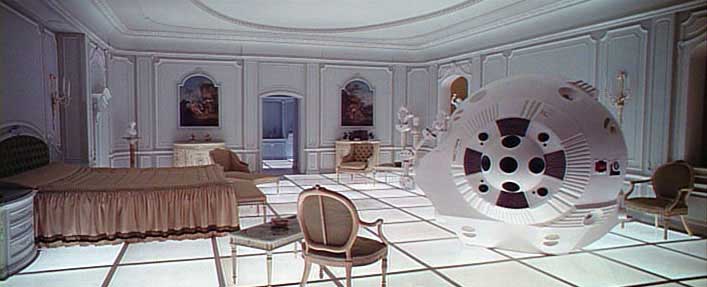
An image from 2001: A Space Odyssey