Dan in Real Life is a typical Hollywood, sentimental comedy, but it's funny and enjoyable enough to merit a recommendation. Steve Carell gives yet another funny, likable and relatable role where he does very well. He mixes the dramatic and comedic moments without being too slapstick or too sentimentally cloying. He does succeeds in having very good chemistry with Juliette Binoche and the three actresses playing his daughters, all of whom provide nice work. Meanwhile, Dane Cook, who I have not seen in anything beforehand, provides a tolerable performance. Emily Blunt is also fun in a small role.
Peter Hedges's screenplay is smart and funny without going into the "offend everyone" root, although there are times when he puts some cliches in the film, that we have seen time and time before. Nonetheless, it's a nice way to spend an hour and a half. Full Metal Jacket
Stanley Kubrick was known as an original filmmaker, always tapping into areas in ways different than what other people attempted. With Full Metal Jacket, Kubrick went with the familiar: The Vietnam War, a subject tackled time and time again in other films (most notably Oliver Stone's terrific semi-autobiography Platoon). However, Kubrick unfortunately does nothing to set this film apart from the others, which is why this ranks as his weakest films. That doesn't stop it from being a very well made film.
The best moments in the film come in the first act, as we see many men prepare for the harshness of war, yet one goes over-board. R. Lee Ermey and Vincent D'Onofrio play off each other very well, with one transforming the other. With the Gomer Pyle character, Kubrick gives the character a similar change to somebody in one of his previous films: Alex in A Clockwork Orange. However, while Alex goes from wicked to harmless, Pyle exhibits the opposite effect, with Ermey and soaps wrapped in towels playing the role of his Ludovico technique. D'Onofrio goes into a transformation showing how the army changes harmless "maggots" into killing machines. It's a scary thought that Kubrick brings forth in the film.
After that thrilling segment, the film enters into ironically as one character mentions, "Vietnam: The Movie." The film feels very much like Platoon with Matthew Modine acting a bit like the Charlie Sheen character in that film. Not the say the next two acts aren't exciting, as they continue to show Kubrick's great directing and writing skills, but the familiarity ruins the fun a bit. And each soldier feels like just another soldier with an interesting nickname.
Despite all of that, Full Metal Jacket still proves to be a winning entry in Kubrick's impressive filmography and a film people should certainly see.
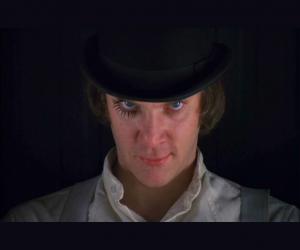
Stanley Kubrick's brilliant adaptation of Anthony Burgess's terrific book is more than just a violent, disturbing, shocking science-fiction film. A Clockwork Orange is a critique on not only disturbed youth, but also the government who tries to take away their freedom of choices. Malcolm McDowell's performance is able to bring these critiques out even more with his transformation. At the beginning, his character of Alex performs horrific acts of "ultra-violence" and rape. He's unlikable and we wait for him to get what he deserves. Later, when a governmental brainwashing experiment takes away his ability to choose, we have a change of heart. A character who the audience hates at the beginning soon feels sorry for him. Alex's change is portrayed perfectly by McDowell, who goes from a sadistic meanie to just a young lad who can't defend himself.
The language of "nadsat" is transfered very well from the book with Kubrick keeping it intact and not distorting it. His use of classical music also works well with the film with the original score giving ample support to the scene. From the opening shot of Alex looking into the camera, to the end ("I was cured alright"), we're fascinated from start to finish. Despite the omission of the final chapter, Kubrick still keeps Burgess's original story, while adding his own feel as only he can.
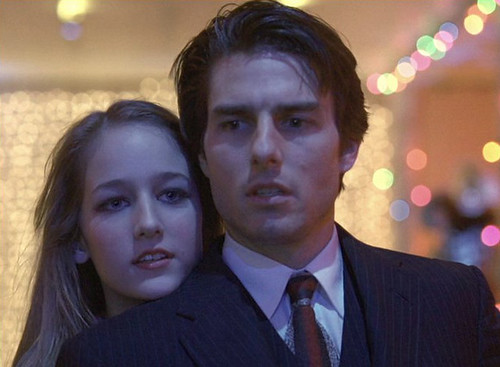
Stanley Kubrick's final film is such a perfect way to end such a brilliant a career. His use of visual imagery comes into perfect use here, as everything from the lighting to the cinematography is top-notch. Also of note is the music which almost feels like a heart beat, showing the viewer how hard Dr Hartford's heart is pumping at those moments. Tom Cruise's terrific performance also helps things, where he's able to make us see plenty by looking at his eyes. A man consumed by his wife's recent revelation, we see that it can lead him to do anything, including attending a masked orgy. Nicole Kidman isn't in the film as much as Cruise, but she provides great work, delivering monologue after monologue with perfection. Of course, who but Kubrick and his numerous takes could manage to do it? Eyes Wide Shut is not such a study on sex, but also a story that unravels at every turn, as every plot detail becomes unraveled for not such the viewer, but Dr Hartford as well.
While other recent film musicals like The Producers, Chicago and Moulin Rouge lost none of their impact when brought to home video, Dreamgirls suffers when shown on a smaller medium. In the cinema, it felt like a full-blown Broadway musical with some terrific songs and star-making performances. On the small screen, all of these are greatly reduced and the flaws become more evident. The most notable comes from the songs. While the music is still catchy, the lyrics are too sappy and sound like the song writer did them in his sleep. Jennifer Hudson's award-winning performance also loses it's grandeur and goes from "surprisingly great" to "rather good."
However, there are still things that don't change in the transition. Eddie Murphy manages to show his dramatic side with a wonderful performance as a man whose life continues to be stepped down and soon goes down a bad path. The dance numbers still retain their energy and Bill Condon's direction still works very well, although his script doesn't. Finally, the art direction, costumes, editing, photography and lighting still hold their Broadway-style feel. The film is still very good, but unlike those previously mentioned musicals, just hasn't made a good translation from projection to digital video disc.
Stanley Kubrick's The Shining is more than just a horror film. The Shining is a psychological case study on the effects of isolation on the human mind. Kubrick and Jack Nicholson show on screen as the main character slowly descends into madness and soon sees ghosts, particularly a Mr Grady a former caretaker at the hotel, who presents with grotesque ideas of what to do with the family. Jack's son, Danny, also has an imaginary friend, who warns him of impending danger, unlike Grady who leads Jack into creating danger. In this, Kubrick provides an interest contrast: the innocence of childhood and the need to protect it and the madness of adulthood. It is quite possible that Danny could be very traumatised by the events at the Overlook Hotel and could one day end up like his father.
The creepy atmosphere that Kubrick brings to the set, adds to the film's scariness and watching the film again, we instantly recognise (in one scene where Jack and his wife are shown the hotel) locations that we will play a major role later on in the transition Jack goes through. The film's score, with it's twanging violins and eerie notes also make the film all the more creepy. If there's a sour note in the film, it's Shelley Duvall, playing Jack's wife. Throughout the whole film, it's obvious she's "acting" and not doing a good job at it either. This is made even more obvious in "bash your brains in" scene where she confronts Jack. On one end, we get an excellent performance from Nicholson, on the other is Duvall's embarrassing work. Yet, the suspense of the scene is still managed to be saved thanks to Kubrick's direction.
The Shining is a film that much like Kubrick's other works, is a fascinating study on human behavior, while also being a visual splendor and incredibly entertaining.
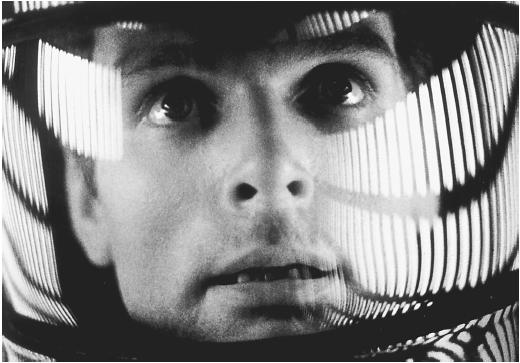
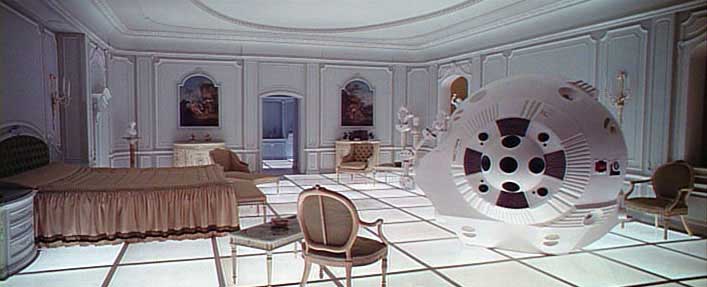
An absolute marvel of a motion picture, 2001: A Space Odyssey defines not on the science-fiction genre, but also cinema as a whole. Stanley Kubrick doesn't rush things and thus gives us a realistic view of space, free of speech and full of wonderment. His use of a classical score only adds even more to the calmness of these opening scenes in space. The film's imagery is absolutely enchanting to watch, with special effects that help the film rather than distract. Despite the film taking place six years ago, 2001 still holds up extremely well.
Yet, despite the film's optimism on space travel in the future, there is also a right amount of pessimism to make it work just right. Probably, the most interesting character in the whole film is the HAL 9000, the computer who suffers a mental breakdown on board. It shows an error that occurs when people try to give computers human feelings, as their control of everything leads them to harm rather than help their creators. Yet, even after his wrong-doings, HAL still displays his calm side. It is not surprise that each letter in HAL's name come right before the letters 'IBM.'
The whole idea of imagery is explored very well in the opening 'Dawn of Man' sequence when the apemen find the monolith. Soon afterwards, they develop a rather violent nature, Kubrick implying that violence is not something we know and do at birth but something we learn and are familiar later on. Similar to HAL, who starts off just knowing a solitary sound and then more information is put in him and like the apes, he learns how to harm and kill.
2001 is a film that can be talked about many times over (and it has) and that is another reason why it's such a masterpiece: The fact that it still holds up as a powerful and beautiful film today. And people are still talking about the ideas that Kubrick and Arthur C. Clarke implanted into the film.
But, if you're looking for a different interpretation...
Lost in Translation has been accused as being boring and slow-moving by some people. I was one of those people, until I watched it again for the first time in four years. Its slow pace is probably one of the film's best qualities. It's soothing and relaxing, like a nice spa and allows the viewer to get into the two protagonist's lives, as we see both of them suffering from similar problems. Bill Murray, in his best performance to date, gives Bob Harris a calmness as he tries to do with the new, unusual world he's in. There is also humour throughout that makes the character a fun fellow. Scarlett Johansson's performance is also of note as, like Murray, she gives the character a touching edge. Sofia Coppola's direction and screenplay also help in the above cases.
Lost in Translation can be best described as a light film, adrift with few cliches and a believable friendship between two individuals, who despite at different stations in life, are both experiencing similar epiphanies.
Mousehunt
A fun family film, Mousehunt doesn't care about realism (as this film has barely any), but to get the viewer to laugh. And it certainly succeeds in that area. Nathan Lane and Lee Evans make a great team and while they don't put the combination of Lane and Matthew Broderick to shame, they still work very well together. The special effects used to create the mouse are also very well done, as they successfully mix real mice, puppets and CGI. Alan Silvestri's score is also one that adds the fun and darkness to the film, with both his main memorable theme and the sentimental music, too. This is a fun film that allows the viewer to escape reality for an hour and half.
 Dan in Real Life is a typical Hollywood, sentimental comedy, but it's funny and enjoyable enough to merit a recommendation. Steve Carell gives yet another funny, likable and relatable role where he does very well. He mixes the dramatic and comedic moments without being too slapstick or too sentimentally cloying. He does succeeds in having very good chemistry with Juliette Binoche and the three actresses playing his daughters, all of whom provide nice work. Meanwhile, Dane Cook, who I have not seen in anything beforehand, provides a tolerable performance. Emily Blunt is also fun in a small role.
 Stanley Kubrick was known as an original filmmaker, always tapping into areas in ways different than what other people attempted. With Full Metal Jacket, Kubrick went with the familiar: The Vietnam War, a subject tackled time and time again in other films (most notably Oliver Stone's terrific semi-autobiography Platoon). However, Kubrick unfortunately does nothing to set this film apart from the others, which is why this ranks as his weakest films. That doesn't stop it from being a very well made film.